
The United States, Russia and China rivalry in the arctic: strategies and stakes
By Gouizi Meriem — 3 min read
For decades, the Arctic remained a distant frozen frontier, largely overlooked in global strategy. Today, climate change has reduced ice levels, revealing vast reserves of oil, gas, and strategic minerals, while new maritime routes are reshaping international trade and global competition.
Why the Arctic Has Become Strategic ?
The United States and Russia, long the dominant Arctic powers, are now joined by China, which seeks a foothold through science, investment, and maritime planning. Each actor approaches the region differently: Moscow relies on its geographic dominance and resource control, Washington leverages military and energy interests in Alaska, and Beijing pursues influence without formal territorial claims. Together, these dynamics are redefining the strategic map of the High North and changing Features of the international system.
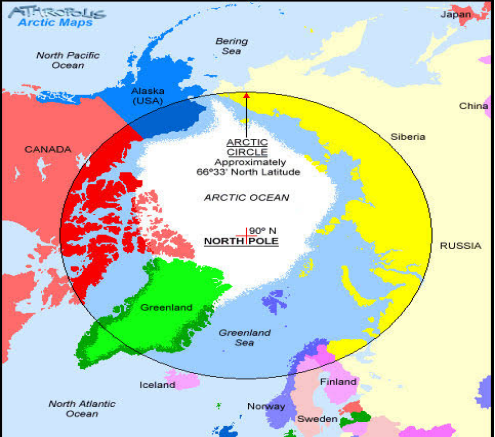
source: Strive Edge 2025
The Arctic Circle includes the Arctic Ocean and the northern territories of Russia, Canada, the United States (Alaska), and several Nordic states, as well as indigenous communities such as the Inuit and Sámi. According to the U.S. Geological Survey, the region contains roughly 13% of the world’s undiscovered oil and nearly 30% of its untapped natural gas.
New maritime passages are emerging, particularly the Northern Sea Route and the Northwest Passage, offering journeys up to 40% shorter between Europe and Asia and granting strategic advantage to nations that control them.
The Arctic’s value extends beyond resources and trade. Militarily, it represents a unique zone of proximity by the Bering Strait which separates Russia and the United States by only 4 kilometers, making the region a potential flashpoint if tensions rise .Geography, energy, and security converge to make the northern frontier increasingly significant on the global stage.
The United States: Alaska as a Strategic Outpost
The United States’ engagement in the Arctic is centered on Alaska, which provides over 1.7 million km² of Arctic territory. Alaska contains roughly 30 billion barrels of undiscovered oil, along with early-warning radar installations and missile defense systems. However, the U.S. faces constraints due to its limited icebreaker fleet compared to Russia, restricting year-round presence and operational capacity.
Russia: Commanding the High North
Russia holds a geographic advantage unmatched by any other Arctic actor, controlling over 50% of the coastline. Since 2014, it has reactivated military bases, deployed air defense systems, and expanded its icebreaker fleet, including nuclear-powered vessels. The Arctic contributes about 20% of Russia’s GDP and roughly 30% of exports, while the Northern Sea Route enhances Moscow’s geopolitical influence.
China: A Strategic Outsider
China has no Arctic coastline but has positioned itself as a “Near-Arctic State.” It seeks influence through scientific research, economic investment, and infrastructure development. China participates in Russian energy projects such as Yamal LNG, where it contributes roughly 30% of the financing.and promotes the Polar Silk Road to shorten shipping times to Europe, by approximately 40%, providing an alternative to the Suez Canal. securing future access to Arctic resources without direct territorial claims.Its approach highlights a key aspect of contemporary Arctic geopolitics: influence does not rely solely on territorial control, as economic partnerships, strategic investments, and technological capabilities can grant leverage,
Beyond Oil and Gas
The Arctic contains substantial mineral and biological wealth, including significant shares of global nickel, copper, zinc, rare earth elements, and about 10% of the world’s commercial fish stocks. These resources provide economic leverage while increasing environmental and governance challenges.
Challenges and Uncertainty
Despite the opportunities, the Arctic remains highly unpredictable due to fluctuating ice conditions, limited infrastructure, legal disputes over navigation rights, and environmental risks such as oil spills and overfishing. These dynamics magnify strategic competition among Arctic and non-Arctic states.
Overall , the Arctic is no longer a remote, frozen wilderness but a strategic space where cooperation is increasingly essential. The Arctic Council plays a central role in promoting dialogue, environmental protection, scientific research, and indigenous participation. Ultimately, the future of the High North will depend not only on competition among major powers but also on effective multilateral governance and long-term environmental stewardship.