

In the South China Sea, China does not fight battles as the West understands them. It plays a game older than empires, subtler than brute force, infinitely patient. Like a master of Go, Beijing does not seek decisive victories but shapes the board itself—placing islands as stones, cultivating influence, and constructing positions so strong that rivals are compelled to respond on its terms. Each reef transformed, each airstrip laid, each patrol dispatched is part of a deliberate strategy of inevitability. Understanding China’s maritime ascent requires looking beyond dredgers and missiles, toward the strategic geometry it quietly builds—a game in which control emerges not from confrontation, but from the patient art of shaping space, time, and perception. Each stone, each placement, contributes to a broader structure that gradually dominates the board. China’s islands function precisely in this way: nodes in a sprawling, interconnected network of influence, designed less to provoke conflict than to make any challenge strategically costly.
This dynamic generates an urgent question:
How is China’s island-building reshaping power dynamics in the South China Sea and signaling the future of maritime dominance in the 21st century?
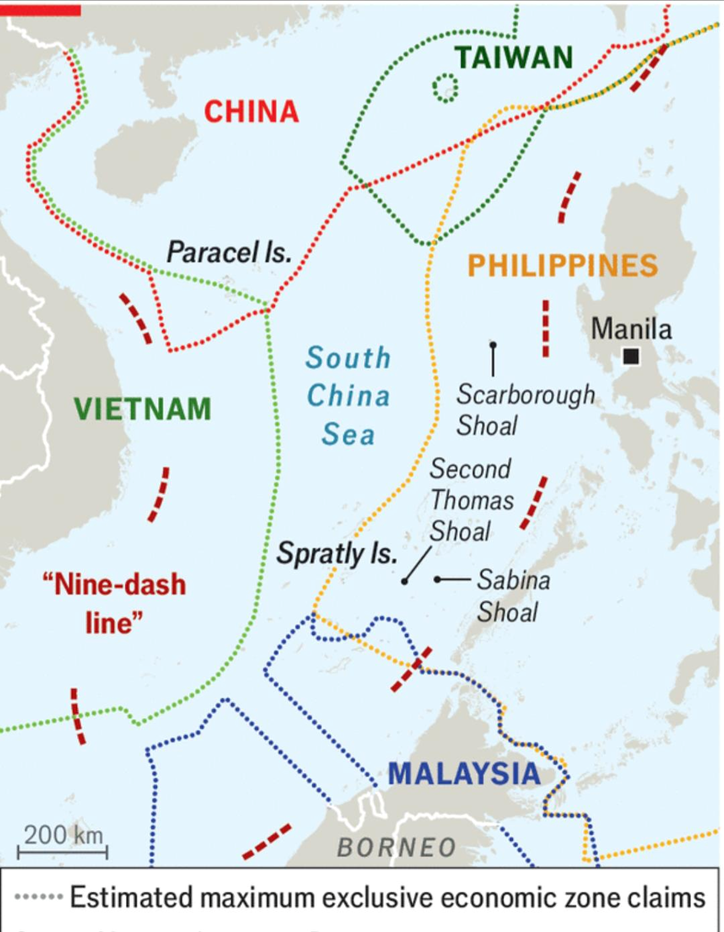
Image source: The Economist (2024).
Artificial islands in the Spratly and Paracel chains serve as points of structural accumulation. Between 2013 and 2018, China reclaimed more than 3,200 acres—more than all other claimants combined throughout history. Every reef that is turned into an island becomes a center of gravity, exuding influence through its dual-use infrastructure, military presence, and civilian integration. Hardened shelters, airstrips, radar systems, and ports exist alongside research facilities, tourist amenities, and communication hubs. The result is this hybrid civilian-military approach, what Go players call “thickness.” A position is resilient to attack, flexible in function, and capable of shaping the opponent’s responses before any confrontation occurs. The Western concept tends to focus on military hardware; however, in the Chinese strategic thought, its purpose is not just force projection but changing the environment itself psychologically, economically, and politically.
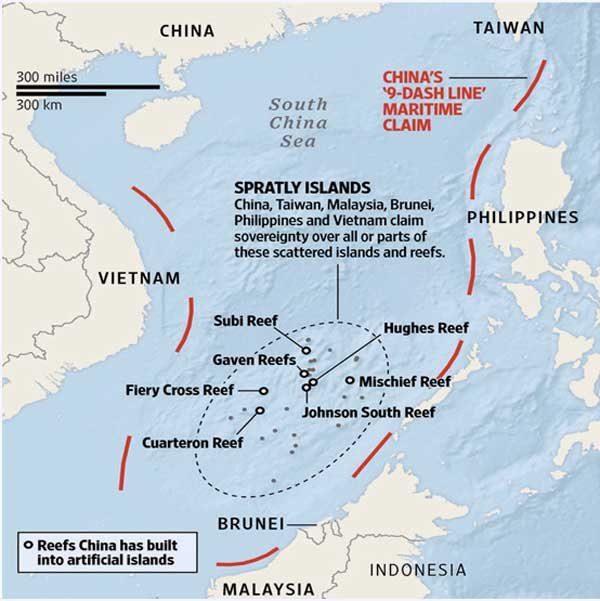
Image source: IAS Aarthi (2024).
The South China Sea is much more than a maritime theater; it’s a strategic corridor for global commerce and energy flows. More than $3.5 trillion in trade passes through each year, including energy imports crucial to China’s industrial economy.
• Fisheries:
12% of global fish catch; vital food security for 270M+ people.
• Oil:
≈11B barrels; major energy leverage for China & ASEAN.
• Natural Gas:
≈190 Tcf; crucial industrial and regional energy supply.
• Shipping Routes:
$3.5T trade yearly; 30% of global maritime traffic.
• Minerals:
Sand & rare earths; essential for high-tech manufacturing.
• Tourism / Development:
50+ islands developed; economic growth and dual-use facilities.
• Military Control:
7+ fortified reefs; surveillance and force projection.
• Environmental Value:
Coral reefs & biodiversity; ~50% under threat.
• Geopolitical Influence:
Nine-Dash Line claims; ~90% of the sea under Chinese assertion.
The ability to create a network of islands enables Beijing to enforce a form of spatial governance without requiring direct occupation of every feature. As in Go, influence is as decisive as territory. China’s approach depends on shaping the possibilities available to others: forcing rivals to react, adapt, or refrain from particular moves altogether. Even in the absence of formal sovereignty, the physical and psychological presence of these islands limits actions by other claimants and external powers alike. This structural approach extends into the forces supporting China’s objectives at sea. The People’s Liberation Army Navy provides the conventional strength, while the maritime militia-civilian vessels acting under coordinated command-operates in the strategic grey zone. These shadow and monitor competitors, subtly impeding them without crossing into overt conflict. Like Go stones, they can attach, reinforce, or withdraw as needed, allowing flexibility and maintaining initiative. This is the principle of sente : dictating the tempo of the game, compelling others to respond, and making the opponent’s reactions part of one’s strategy. In contrast, Western naval operations often focus on limited challenges to freedom of navigation; these resemble discrete chess maneuvers played upon a board conceived differently-capable of tactical effect but not able to restructure the underlying strategic geometry China has carefully built.
The Nine-Dash Line serves as a conceptual extension of this Go-like approach. Ambiguity is intentional: instead of clearly defined boundaries, China projects influence through historical and cultural claims, forming expectations without the necessity of immediate occupation. The ruling of the Permanent Court of Arbitration in 2016 dismissing China’s historic claims did not importantly challenge Beijing’s strategy. Far from pulling back, China expanded its presence, securing existing positions and generating new nodes of influence. In Go terminology, when pressure to one sector is applied, strength is used elsewhere to solidify overall advantage. This elasticity is at the center of understanding Chinese behavior: influence is cumulative, not reactive.
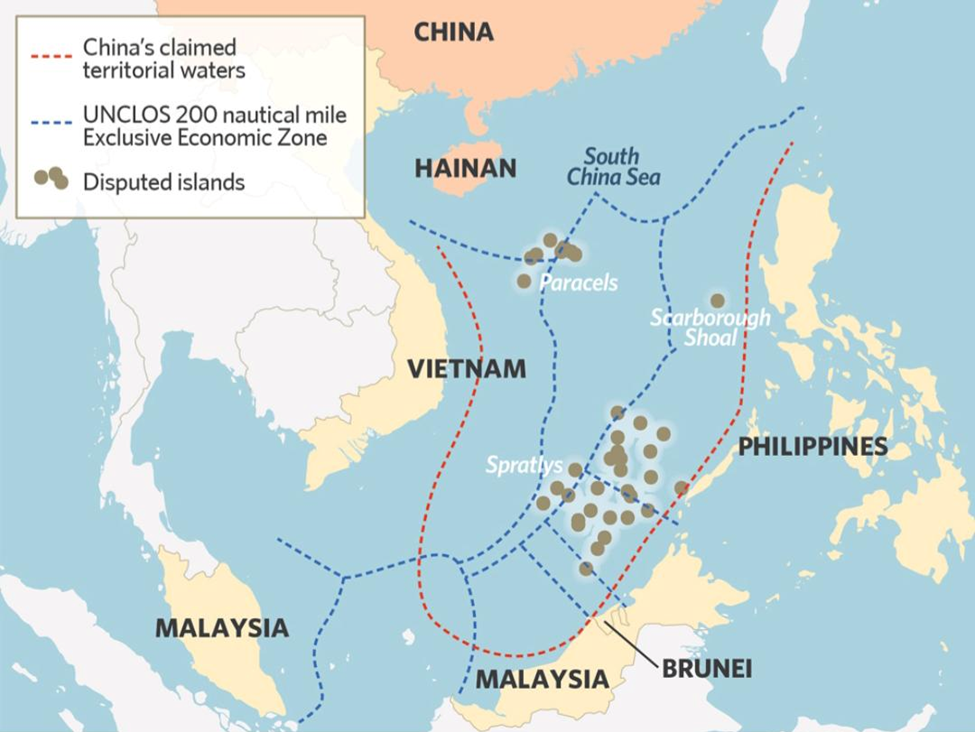
Image source: Peace Palace Library (2016).
Civil-military fusion increases the strategic sophistication of island development. By embedding research laboratories, meteorological centers, tourism infrastructure, and communications alongside radars and missile batteries, China achieves multiple objectives at once: the islands project permanence and normalize Chinese presence in support of dual-use functions without the optics of overt militarization. As in Go, the placement of multifunctional stones aims to enhance overall board position for both defense and influence expansion; the strategic benefit lies not at single-point superiority, but in the creation of a resilient, interconnected structure that shapes the broader environment. This is further reflected in the regional balance. The Philippines and Vietnam engage in tactical countermeasures-legal challenges, alliances, limited reclamation-but their isolated moves lack the structural depth to reshape the board. ASEAN, divided by economic and political ties with China, often remains reactive, unable to mount a coherent collective strategy. The U.S., while capable of projecting military power, is constrained by the mismatch between its high-value interventions and the distributed, structurally embedded nature of China’s positions. Freedom-of-navigation operations disrupt or deter individual actions, but cannot dislodge the strategic foundation China has built. In Go, these are isolated tactical skirmishes; they matter locally but do not alter the larger formation.
Economics underpins this positional advantage. ASEANChina trade exceeds $970 billion, creating interdependencies that reinforce structural influence. Economic leverage becomes a form of strategic thickness: rival states may protest militarily or diplomatically, but the cost of sustained confrontation rises with each interlinked transaction, investment, and supply chain dependency. Similarly, civil-military integration on the islands transforms perception: infrastructure and commerce suggest normalization, gradually embedding Chinese presence in ways resistant to disruption.
Legal norms are another facet of influence but also subordinate to strategic reality. UNCLOS provides a framework, yet there is limited enforcement. While judgments can be pronounced by courts, without material follow-through, law cannot reshape positions already entrenched. Chinese scholars underline how normative frameworks survive only when they go along with the distribution of power. In the South China Sea, the geography changes and the building of infrastructure runs way ahead of legal interpretation to show how strategic construction can pre-empt normative constraints.
The risks are evident within China’s approach: environmental degradation, nationalist expectations, and potential misjudgments of escalation. Yet in Go, risk is inseparable from the process of influence-building. Expansion inevitably leaves weaknesses, but the calculus lies in whether the overall structure remains stronger than the opponent’s capacity to exploit gaps. To date, China’s networked islands and maritime presence maintain sufficient cohesion so as to make direct challenge unattractive, if not prohibitive. Permeating all of this is a deep-seated divide in strategic thought. Western military thinking favors decisive engagement-a clash whose result settles the issue. Chinese naval strategy, based on Go, favors incremental gain, shaping the opponent’s choices and creating irreparable positional facts on the ground. Islands, militia, dual-use infrastructure, and narrative construction are but pieces in a game whose ending, or victory condition, is marked by inevitability , not annihilation. By progressively hemming in options, China edges closer to that moment when overt conflict becomes superfluous because the board has long since tipped irretrievably in its direction.
In this light, China’s artificial islands represent conceptual instruments as much as physical objects. They represent the power thought of both in material and psychological terms, as one continuing projection of influence across time and space. Each reclaimed reef represents a move toward structural dominance, each civilian-military fusion point reinforces presence, and each ambiguous legal claim shapes expectations. The South China Sea becomes less a theater of combat and more a canvas for strategic imagination, where geography, perception, and law intersect under the patient hand of a Go player. By applying Go as both metaphor and analytic lens, it becomes clear that China’s actions are not impulsive or purely militaristic; they are deliberate, cumulative, and irreversible. The strategy operates simultaneously on multiple planes-military, economic, legal, and psychological-creating a multi-dimensional architecture of influence. Whereas Western observers may frame the debate in terms of battles or immediate gains, China operates on the logic of position, influence, and inevitability , ensuring that when rivals act, they are responding to a board already shaped in Beijing’s favor.
What it means is that China is not fighting for immediate control; it’s creating a landscape where control becomes self-reinforcing. The islands, the militia operations, economic leverage, and legal posturing add up to one long game in shaping perception, opportunity, and strategic geometry. In the South China Sea, the board is set; each stone is placed with foresight, patience, and precision. The ultimate advantage lies not in confrontation but in the art of positional inevitability. Viewed through this lens, the South China Sea becomes not a contested maritime space but rather a vast Go board on which China is playing a subtle, patient, and structurally profound game: an integration of geography, psychology, and policy that renders its dominance natural, unavoidable, and irreversible. Its greatest asset is neither its navy nor its dredgers but knowing that the true power of Go and of maritime strategy lies in shaping the possibilities well before confrontation is even required.
In the South China Sea, China moves like a master of Go patient, strategic, and focused on shaping the board rather than fighting battles. Its strategy carries a Mahanian ambition, securing sea lanes and projecting maritime power, and a Napoleonic vision, reshaping the regional order with deliberate, coordinated moves. Each island, patrol, and installation is simultaneously a stone, a fleet, and a campaign building a structure of influence so cumulative and resilient that power becomes inevitable.
References
Bhatt, P. (2024). Nine-Dash Line: Deciphering the South China Sea conundrum. Routledge.
Erickson, A. S., & Kennedy, C. M. (n.d.). Strategies of China’s maritime actors in the South China Sea. China Perspectives.
(Add year if known.)
Gunaratna, R., & Amarasinghe, P. (2024). From Mahan to Corbett: An inquiry into the development of Chinese naval strategy in the Indian Ocean region. Journal of Indo-Pacific Affairs.
Guo, W., Du, D., Li, X., Xia, Q., & Cao, W. (2022). Spatial characteristics of arms trade patterns of the South China Sea region and its geopolitical implications. World Regional Studies.
Lai, D. (2004). Learning from the stones: A Go approach to mastering China’s strategic concept, shi. Strategic Studies Institute, U.S. Army War College.
Mahan, A. T. (n.d.). The influence of sea power upon history.
(Add publication year and publisher for APA completeness.)
Modern Diplomacy. (2025, February). China’s influence operations in the South China Sea and the Global South as a means of power projection.
Nicchiarelli, P. (2023). Maritime grey zone operations in the South China Sea (Master’s thesis). King’s College London.
Sasaki, F. (2025). Space, maritime security, and geopolitics in the South China Sea. Journal of Indo-Pacific Affairs.
Schultheiss, C. (2023). What has China’s lawfare achieved in the South China Sea? ISEAS Perspective, 2023(51).
Shih, C., & Huang, C. (2020). Competing for a better role relation: International relations, Sino–U.S. rivalry and game of Weiqi. Journal of Chinese Political Science, 25(5).
The Diplomat. (2023, November). China’s bid to construct a “maritime community with a shared future” in the South China Sea.
Zhao, P. W. G. (2023). China’s 21st-century maritime strategy: A naval-historical dialogue between Mahan and Corbett. European Journal of East Asian Studies, 22(2).